| Introduction |
| ------------------------------------------------------------ |
| |
| supervise is a Clojure library for managing a worker thread |
| through a synchronized lifecycle. A component wraps a worker |
| function and provides synchronous lifecycle operations |
| through start! and stop!. State transitions can be observed |
| through an optional callback. |
| |
| Work in progress: supervise is under active development. Its |
| API, semantics, and implementation details may still change. |
| The library should not yet be considered a stable production |
| dependency. |
| |
| |
| Installation |
| ------------------------------------------------------------ |
| |
| This library can be installed from Clojars [1]. |
| |
| |
| Creating a component |
| ------------------------------------------------------------ |
| |
| Create a component by passing a worker function and, |
| optionally, an options map to component: |
| |
| (require '[supervise.core :as supervise]) |
| |
| (def service |
| (supervise/component |
| (fn [interrupt-token] |
| (loop [] |
| ;; Perform the worker's task. |
| (supervise/await! interrupt-token 1000) |
| (recur))) |
| {:restart-after-termination? true |
| :restart-after-failure? true |
| :on-transit println})) |
| |
| When no options are needed, the options map can be omitted: |
| |
| (def service (supervise/component worker-fn)) |
| |
| The worker function, options map, and values assigned to |
| supported options are validated when the component is |
| created. Invalid arguments cause an ExceptionInfo containing |
| Clojure Spec explanation data. |
| |
| The worker function receives an interrupt token. check! |
| checks whether the worker has been interrupted, while await! |
| waits for the specified number of milliseconds. Both |
| functions must be called from the worker thread associated |
| with the token. They throw InterruptedException after an |
| interrupt. When the interrupt was requested by stop!, |
| supervise handles it as the worker stopping normally. An |
| InterruptedException without an active stop request is |
| treated as a worker failure and retained as its cause. |
| |
| |
| start! |
| ------------------------------------------------------------ |
| |
| (supervise/start! service) |
| |
| start! starts the worker and blocks until it has reached |
| :running. It returns nil on success. |
| |
| The exact behavior depends on the component's current state: |
| |
| * In :stopped, a new worker generation is created and |
| started. |
| * In :starting, the call waits for the start already in |
| progress. It does not create a second worker. |
| * In :running, the call has no effect and immediately |
| returns nil. |
| * In :stopping, the call waits until the current worker |
| has stopped and then evaluates again whether it may |
| start a worker. |
| * In :terminated, a new worker is started only when |
| :restart-after-termination? is enabled. Otherwise, |
| start! throws an ExceptionInfo containing the |
| :terminated state. |
| * In :failed, a new worker is started only when |
| :restart-after-failure? is enabled. Otherwise, start! |
| throws an ExceptionInfo containing the :failed state and |
| the original failure as its cause. |
| |
| If the underlying Java thread cannot be started, the |
| component transitions to :failed, and start! rethrows the |
| error. |
| |
| Concurrent calls to start! create only one worker for the |
| same start attempt. The other calls wait for that worker to |
| start or observe that the component is already running. |
| |
| The component's own worker must not call start! while the |
| component is stopping because it cannot wait synchronously |
| for its own thread to terminate. Such a call is rejected |
| with an IllegalStateException. |
| |
| |
| stop! |
| ------------------------------------------------------------ |
| |
| (supervise/stop! service) |
| |
| stop! attempts to interrupt a running worker and blocks |
| until its thread has terminated. Once the thread terminates, |
| it returns nil even when the worker finishes in :failed; the |
| failure remains observable through :on-transit and when |
| automatic restart after failure is disabled, as the cause of |
| a subsequent rejected start!. |
| |
| If interrupting the worker throws, stop! propagates the |
| exception. The component remains in :running, and no |
| :stopping notification is emitted, so a later stop! can try |
| again. |
| |
| Its exact behavior also depends on the current state: |
| |
| * In :starting, the call first waits for the start to |
| complete and then tries to stop the component again. |
| * In :running, the call interrupts the worker while |
| holding the lifecycle lock. If the interrupt succeeds, |
| the component transitions to :stopping and the call |
| waits for the worker thread to terminate. |
| * In :stopping, the call waits for the stop already in |
| progress to complete. |
| * In :stopped, :terminated, or :failed, the call has no |
| effect and immediately returns nil. |
| |
| stop! must not be called synchronously from the component's |
| own worker thread. Such a call could wait for the same |
| thread to terminate and is therefore rejected with an |
| IllegalStateException. A worker should instead return from |
| its function when it needs to terminate itself. |
| |
| Interruption is cooperative: the worker must react to the |
| interrupt, for example by calling check! or await!, or by |
| using another interruptible operation. If it ignores the |
| interrupt, stop! continues waiting until the worker actually |
| terminates. |
| |
| |
| States |
| ------------------------------------------------------------ |
| |
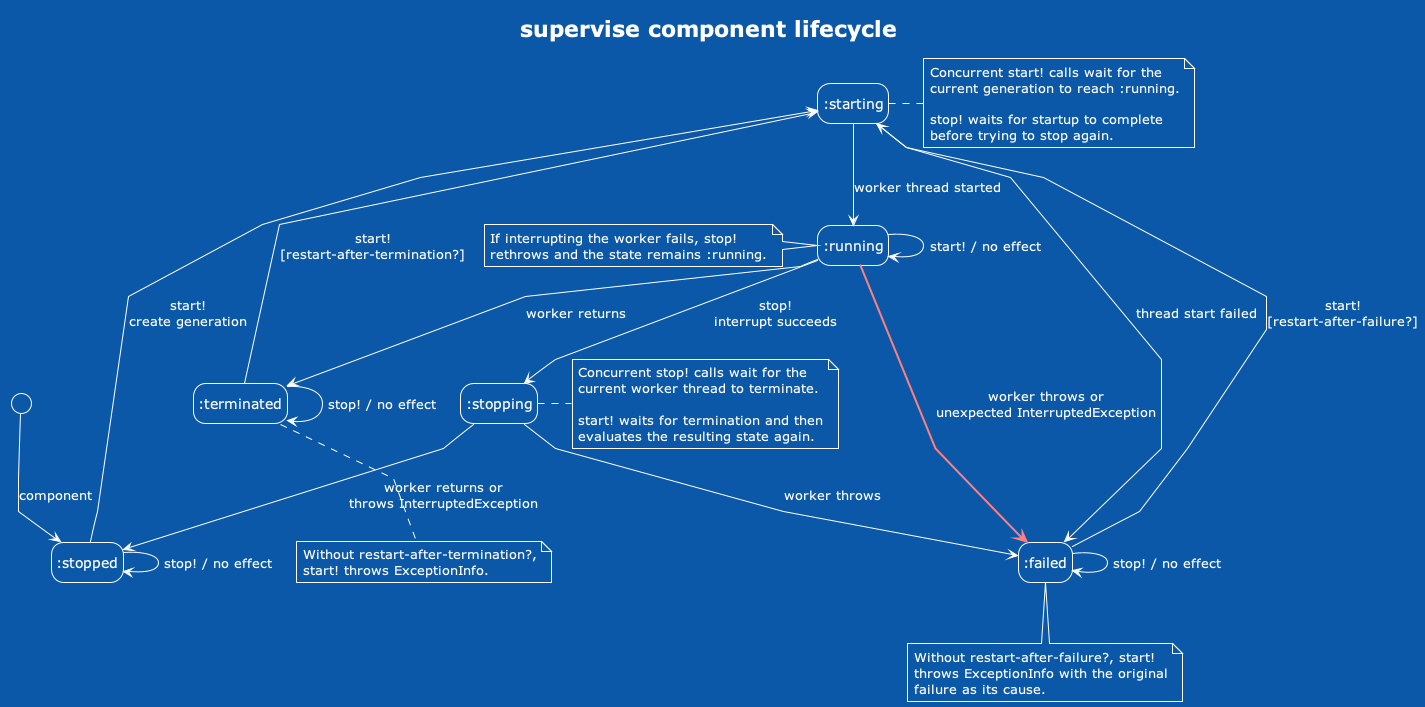
| A component can be in one of the following states: |
| |
| :stopped |
| The initial state or the result of a successful stop!. No |
| worker is running. |
| |
| :starting |
| A new worker generation has been created, but its thread |
| has not yet reported :running. |
| |
| :running |
| The worker has started and is executing its function. |
| |
| :stopping |
| The worker has been asked to stop, but its thread has not |
| yet terminated. |
| |
| :terminated |
| The worker function returned on its own without an error. |
| |
| :failed |
| The worker function, an unexpected interruption, or the |
| attempt to start its thread failed. The error is retained |
| as the cause. |
| |
| |
| Lifecycle diagram |
| |
| |
| Restart options |
| ------------------------------------------------------------ |
| |
| :restart-after-termination? |
| --------------------------- |
| |
| When this option is true, start! may start a new worker |
| generation for a component in :terminated. Without the |
| option, a component whose worker terminated normally cannot |
| be started again. |
| |
| {:restart-after-termination? true} |
| |
| |
| :restart-after-failure? |
| ----------------------- |
| |
| When this option is true, start! may start a new worker |
| generation for a component in :failed. The previously stored |
| failure is cleared for the new start. Without the option, |
| start! exposes the previous failure as its cause. |
| |
| {:restart-after-failure? true} |
| |
| Both options are disabled by default and accept boolean |
| values. They affect only start! in their respective terminal |
| states. A worker that was explicitly stopped can always be |
| started again from :stopped. |
| |
| |
| Lifecycle notifications and generations |
| ------------------------------------------------------------ |
| |
| Use :on-transit to register a function that receives a map |
| for every state transition: |
| |
| {:on-transit |
| (fn [{:keys [generation from to cause]}] |
| (println "Generation" generation ":" from "->" to) |
| (when cause |
| (println "Cause:" cause)))} |
| |
| Each notification contains the following keys: |
| |
| * :generation is the worker generation number. It starts |
| at 1 for the first start and increases whenever a new |
| worker is actually created. |
| * :from is the previously reported state. |
| * :to is the new state. |
| * :cause is the original throwable and is present only |
| when :to is :failed. |
| |
| Callbacks run asynchronously, but in the same order as the |
| state transitions. A slow callback therefore does not block |
| start!, stop!, or the worker. Callback errors are caught so |
| that subsequent notifications can still be delivered. |
| |
| Listeners can also be added and removed while the component |
| is running: |
| |
| (def listener #(println "transition:" %)) |
| |
| (supervise/add-listener! service listener) |
| (supervise/remove-listener! service listener) |
| |
| Listeners run asynchronously. Registering the same listener |
| more than once has no effect, and their invocation order is |
| unspecified. Removing an unknown listener has no effect. |
| Because delivery is asynchronous, an event already queued |
| when a listener is removed may still be delivered to it. |
| |
| |
| References |
| ------------------------------------------------------------ |
| [1]: Clojars |
| |
| |
| Links |
| ------------------------------------------------------------ |
| main.zip |
| GitHub |