| Introduction |
| ------------------------------------------------------------ |
| |
| Paperboy |
| |
| |
| Paperboy is a Clojure abstraction for reliably passing |
| messages to arbitrary brokers. It provides the building |
| blocks needed to buffer, order, claim, deliver, and |
| acknowledge messages between an application and a |
| destination system. |
| |
| For example, Paperboy can provide a persistent buffer |
| between an application and a messaging system such as MQTT. |
| More generally, it can sit in front of any destination that |
| may be temporarily unavailable: the application submits a |
| message to Paperboy, which can persist and deliver it |
| independently of the calling code and retry it later when |
| necessary. |
| |
| Project status: Paperboy is at an early stage of |
| development. Its API, protocols, data model, and behavior |
| are still subject to change. The current implementations |
| primarily exist to develop and validate the architecture and |
| its concurrent workflows. |
| |
| |
| Installation |
| ------------------------------------------------------------ |
| |
| This library can be installed from Clojars [1]. |
| |
| |
| Architecture |
| ------------------------------------------------------------ |
| |
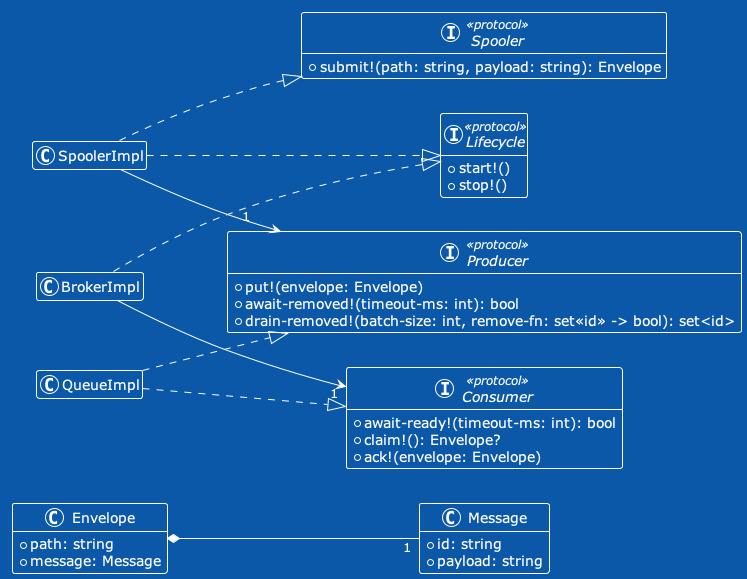
| Paperboy consists of three separate components: |
| |
| 1. The Spooler accepts new messages from the application. |
| 2. The Queue coordinates available, in-flight, and |
| successfully delivered messages. |
| 3. The Broker takes messages from the queue and transmits |
| them to the destination system. |
| |
| Architecture |
| |
| |
| The components communicate through small Clojure protocols. |
| Each implementation can therefore be replaced independently. |
| A persistent spooler does not need to know which concrete |
| queue or broker is being used. Similarly, a broker does not |
| need to know whether messages were persisted in memory, a |
| file, or a database. |
| |
| |
| Envelopes and messages |
| ---------------------- |
| |
| Paperboy transports each message inside an envelope: |
| |
| {:path "/sensors/temperature" |
| :message {:id "1" |
| :payload "21.5"}} |
| |
| An envelope contains: |
| |
| * :path: the logical destination, such as a topic, |
| channel, or routing key; |
| * :message: the message itself, containing: |
| * :id: a unique identifier used to coordinate delivery |
| and deletion; |
| * :payload: the content to transmit. |
| |
| |
| Message flow |
| ------------ |
| |
| Message flow |
| |
| |
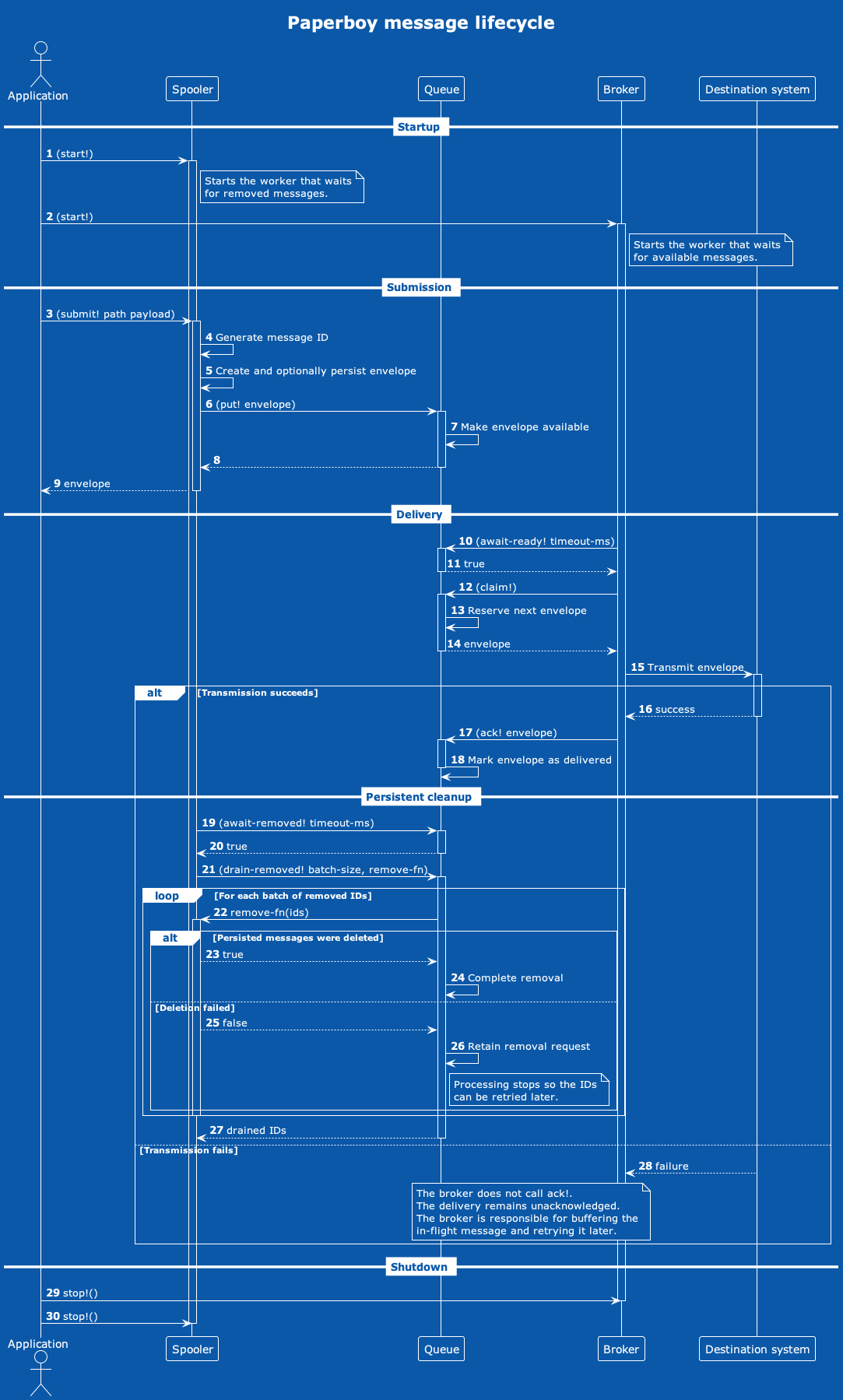
| The message flow separates accepting a message from |
| delivering it and from cleaning up its persisted copy. |
| |
| 1. The application submits a path and payload to the |
| Spooler using submit!. |
| 2. The Spooler assigns a unique ID and creates an |
| envelope. A persistent implementation stores the |
| message before making it available for delivery. |
| 3. The Spooler passes the envelope to the Queue using |
| put!. |
| 4. The Queue makes the envelope available and notifies a |
| waiting Broker. |
| 5. The Broker waits for work with await-ready! and |
| reserves the next envelope with claim!. |
| 6. Claiming prevents another Broker from processing the |
| same delivery concurrently. It does not mean that the |
| message has been delivered successfully. |
| 7. The Broker transmits the envelope to its destination. |
| |
| If transmission succeeds, the Broker calls ack!. The Queue |
| records the successful delivery and notifies the Spooler |
| that the corresponding persisted message may be removed. The |
| Spooler's cleanup worker waits for this notification with |
| await-removed!, obtains acknowledged message IDs in batches |
| through drain-removed!, and deletes their persisted copies. |
| A batch is completed only when the Spooler's removal |
| function reports success; otherwise, the removal request is |
| retained for a later attempt. |
| |
| If transmission fails, the Broker must not call ack!. The |
| delivery remains unacknowledged, and the Broker is |
| responsible for buffering the in-flight message and retrying |
| it later. This allows each Broker implementation to apply |
| the retry, backoff, and destination-specific error-handling |
| strategy appropriate for its transport. |
| |
| |
| Spooler implementations |
| ----------------------- |
| |
| paperboy.spooler.passthrough is a non-persistent Spooler. It |
| assigns message IDs and forwards envelopes directly to the |
| Queue. |
| |
| paperboy.spooler.rocksdb persists messages in a RocksDB |
| database before making them available to the Queue. When it |
| is created, it restores all messages still present in the |
| database in ascending ID order. Its cleanup worker removes |
| messages from RocksDB after the Queue reports that they were |
| acknowledged or evicted. |
| |
| (ns persistent-example |
| (:require [paperboy.api :as api] |
| [paperboy.queue.fifo :as fifo] |
| [paperboy.spooler.rocksdb :as rocks])) |
| |
| (def queue (fifo/fifo)) |
| (def spooler (rocks/rocksdb "var/paperboy" queue)) |
| |
| (api/start! spooler) |
| (api/submit! spooler "/notifications/email" "hello") |
| |
| ;; Stops cleanup and closes the RocksDB database. |
| (.close ^java.io.Closeable spooler) |
| |
| Message IDs are unique among messages retained by a RocksDB |
| Spooler, but are not globally monotonic across restarts. If |
| higher IDs have already been removed, they may be assigned |
| again after the Spooler is reopened. The Queue connected to |
| this Spooler must contain only envelopes submitted through |
| that Spooler. |
| |
| |
| Queue implementations |
| --------------------- |
| |
| paperboy.queue.fifo offers a simple in-memory FIFO queue. It |
| keeps all waiting envelopes in insertion order and makes |
| them available to Brokers one at a time. |
| |
| paperboy.queue.quota offers an in-memory queue with per-path |
| quotas. It accepts a default quota and optional |
| route-specific quotas: |
| |
| (quota/quota {:size 100 |
| :routes {"/tenants/a/*" {:size 10} |
| "/alerts/?" {:size 20}}}) |
| |
| Quota route patterns use the same path segment rules as |
| envelopes, plus two wildcards: |
| |
| * ? matches exactly one path segment. |
| * * matches the rest of the path. |
| |
| When an envelope is put into the queue, its path is matched |
| against the quota routes. A match uses the matching route's |
| :size, but the bucket is still the concrete matched path. |
| For example, /tenants/a/one and /tenants/a/two both match |
| /tenants/a/*, but they are stored in separate buckets, each |
| with size 10. Paths that match no route use the default |
| :size and the default bucket. |
| |
| When a bucket is full, adding a newer envelope evicts older |
| waiting envelopes from that bucket. Evicted message IDs |
| become ready for cleanup through await-removed! and |
| drain-removed!, just like acknowledged message IDs. |
| |
| |
| Broker implementations |
| ---------------------- |
| |
| paperboy.broker.stdout is a diagnostic Broker that writes |
| each claimed message to *out* and acknowledges it after a |
| successful write. |
| |
| paperboy.broker.mh publishes messages to an MQTT broker |
| through a Machine Head [2] client. The envelope's :path |
| becomes the MQTT topic and its :payload becomes the |
| published payload: |
| |
| (ns mqtt-example |
| (:require [clojurewerkz.machine-head.client :as mh] |
| [paperboy.api :as api] |
| [paperboy.broker.mh :as mqtt] |
| [paperboy.queue.fifo :as pq] |
| [paperboy.spooler.passthrough :as pp])) |
| |
| (def queue (pq/fifo)) |
| (def spooler (pp/passthrough queue)) |
| (def client (mh/connect "tcp://localhost:1883")) |
| (def broker (mqtt/mqtt queue client)) |
| |
| (api/start! spooler) |
| (api/start! broker) |
| (api/submit! spooler "/sensors/temperature" "21.5") |
| |
| The MQTT client owns the connection settings, |
| authentication, and reconnect behavior. Paperboy claims and |
| publishes one envelope at a time. While the client is |
| disconnected or publishing fails, it retains the claimed |
| envelope and retries it before claiming the next one. If |
| publishing succeeds but acknowledging the envelope fails, |
| Paperboy publishes it again. Delivery is therefore at least |
| once, and MQTT consumers must tolerate duplicate messages. |
| |
| During controlled shutdown, stop the Paperboy components and |
| close the MQTT client: |
| |
| (api/stop! broker) |
| (api/stop! spooler) |
| (mh/disconnect-and-close client) |
| |
| |
| Example |
| ------------------------------------------------------------ |
| |
| The following example wires the three components together |
| and deliberately submits messages before starting the |
| Broker. This demonstrates that accepting a message and |
| delivering it are independent operations. |
| |
| (ns example |
| (:require [paperboy.api :as api] |
| ;; The FIFO implements both sides of the Queue |
| ;; abstraction: |
| ;; Producer for the Spooler and Consumer for |
| ;; the Broker. |
| [paperboy.queue.fifo :as pq] |
| |
| ;; Passthrough is a non-persistent Spooler. It |
| ;; creates |
| ;; envelopes and forwards them directly to the |
| ;; Queue. |
| [paperboy.spooler.passthrough :as pp] |
| |
| ;; Stdout is a simple Broker that prints |
| ;; claimed messages and |
| ;; acknowledges them after they have been |
| ;; written successfully. |
| [paperboy.broker.stdout :as pb])) |
| |
| ;; Create the shared Queue. Both the Spooler and Broker |
| ;; receive this same |
| ;; instance, but interact with it through different |
| ;; protocols. |
| (def queue (pq/fifo)) |
| |
| ;; Connect the Spooler to the Producer side of the Queue. |
| (def spooler (pp/passthrough queue)) |
| |
| ;; Start the Spooler's cleanup worker. It waits for |
| ;; acknowledged message IDs |
| ;; and removes their persisted copies. Passthrough has no |
| ;; external storage, |
| ;; so removal always succeeds, while still exercising the |
| ;; complete workflow. |
| (api/start! spooler) |
| |
| ;; Submit two messages. The Spooler assigns an ID to each |
| ;; payload, creates an |
| ;; envelope, and puts it into the Queue. At this point the |
| ;; Broker has not been |
| ;; started, so the messages remain available in FIFO |
| ;; order. |
| (api/submit! spooler "/foo" "hello") |
| (api/submit! spooler "/bar" "world") |
| |
| ;; Connect the Stdout Broker to the Consumer side of the |
| ;; same Queue. |
| (def broker (pb/stdout queue)) |
| |
| ;; Start the Broker worker. It waits for available |
| ;; messages, claims them one |
| ;; at a time, writes them to stdout, and acknowledges |
| ;; successful deliveries. |
| ;; The acknowledgements wake the Spooler's cleanup worker. |
| (api/start! broker) |
| |
| The example creates background worker threads. In a |
| long-running application they normally live for the lifetime |
| of the application. During controlled shutdown, stop both |
| components explicitly: |
| |
| (api/stop! broker) |
| (api/stop! spooler) |
| |
| |
| References |
| ------------------------------------------------------------ |
| [1]: Clojars |
| [2]: Machine Head |
| |
| |
| Links |
| ------------------------------------------------------------ |
| main.zip |
| GitHub |